


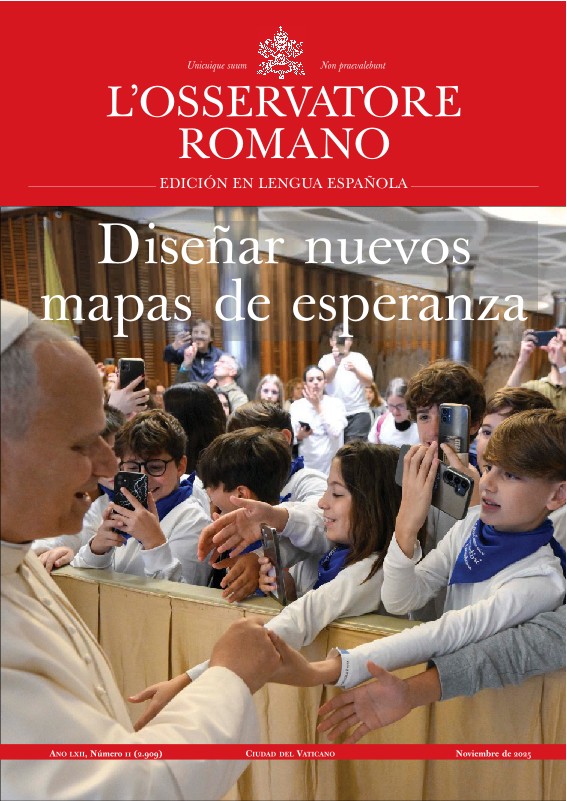
Pope Leo XIV, on the occasion of the 60th anniversary of the Conciliar Declaration 'Gravissimum Educationis', has published an apostolic letter with the title "Designing new maps of Hope."
In this apostolic letter, the Pope Leo XIV He tells us about education as "an act of hope and a passion that is renewed because it manifests the promise we see in the future of humanity." As he reminded us in his Apostolic Exhortation I loved you, education "has always been one of the highest expressions of Christian charity." The world needs this form of hope.
In this context, the Holy Father asks educational communities: "disarm the words, raise your gaze, guard the heart."
1. Prologue
1.1. Design new maps of hope. October 28, 2025 marks the 60th anniversary of the conciliar Declaration Education about the extreme importance and relevance of education in the life of human beings. With that text, andl Vatican Council II He reminded the Church that education is not an accessory activity, but constitutes the very fabric of evangelization: it is the concrete form with which the Gospel becomes an educational gesture, relationship, culture. Today, in the face of rapid change and disorienting uncertainties, that legacy is surprisingly robust.
Where educational communities allow themselves to be guided by the word of Christ, they do not withdraw, but rather relaunch themselves; They don't build walls, they build bridges. They react with creativity, opening new possibilities for the transmission of knowledge and meaning in schools, universities, professional and civil training, school and youth ministry, and research, because the Gospel does not age, but rather "makes all things new" (Ap. 21.5). Each generation hears it as a novelty that regenerates. Each generation is responsible for the Gospel and the discovery of its seminal and multiplying power.
1.2. We live in a complex, fragmented and digitalized educational environment. Precisely for this reason it is wise to stop and look back at the "cosmology of paideia "Christian": a vision that, over the centuries, knew how to renew itself and positively inspire all the multifaceted facets of education. Since its origins, the Gospel has generated "educational constellations": humble and strong experiences at the same time, capable of reading the times, of guarding the unity between faith and reason, between thought and life, between knowledge and justice. They have been, in the storm, an anchor of salvation; and in the bonanza, a sail unfurled. A lighthouse at night to guide navigation.
1.3. The Declaration Education It has not lost strength. Since its reception, a firmament of works and charisms has been born that still guides the path today: schools and universities, movements and institutes, lay associations, religious congregations and national and international networks. Together, these living bodies have consolidated a spiritual and pedagogical heritage capable of crossing the 21st century and responding to the most pressing challenges. This heritage is not immobilized: it is a compass that continues to indicate the direction and speaks of the beauty of the journey. Today's expectations are no less than the many that the Church faced sixty years ago.
Rather, they have expanded and become more complex. Given the many millions of children in the world who still do not have access to primary education, how can we not act? Faced with the dramatic educational emergency situations caused by wars, migrations, inequalities and various forms of poverty, how can we not feel the urgency of renewing our commitment? Education – as I recalled in my Apostolic Exhortation I loved you– “has always been one of the highest expressions of Christian charity” [1]. The world needs this form of hope.
2. A dynamic story
2.1. The history of Catholic education is the history of the Spirit in action. The Church, "mother and teacher" [2], not by supremacy, but by service: generates in faith and accompanies the growth of freedom, assuming the mission of the Divine Master so that everyone "may have life and have it in abundance" ( Jn 10,10). The educational styles that have followed one another show a vision of the human being as an image of God, called to truth and goodness, and a pluralism of methods at the service of this call. Educational charismas are not rigid formulas: they are original responses to the needs of each era.
2.2. In the first centuries, the Desert Fathers taught wisdom with parables and apothegms; They rediscovered the path of the essential, of the discipline of the language and the custody of the heart; They transmitted a pedagogy of vision that recognizes God everywhere. Saint Augustine, by grafting biblical wisdom into the Greco-Roman tradition, understood that the authentic teacher awakens the desire for truth, educates the freedom to read the signs and listen to the inner voice. Monasticism has carried forward this tradition in the most inaccessible places, where for decades classic works have been studied, commented on and taught, in such a way that, without this silent work at the service of culture, many masterpieces would not have survived to this day.
"From the heart of the Church" the first universities emerged, which from their origins revealed themselves as "an incomparable center of creativity and the irradiation of knowledge for the good of humanity" [3]. In its classrooms, speculative thought found in the mediation of the mendicant orders the possibility of being solidly structured and reaching the frontiers of the sciences. Many religious congregations took their first steps in these fields of knowledge, enriching education in a pedagogically innovative and socially visionary way.
2.3. Education has been expressed in many ways. In the Ratio Studiorum, the richness of school tradition merges with Ignatian spirituality, adapting a study program that is as articulate as it is interdisciplinary and open to experimentation. In 17th century Rome, Saint Joseph Calasanz opened free schools for the poor, sensing that literacy and numeracy are dignity rather than competence. In France, Saint John Baptist de La Salle, "aware of the injustice of the exclusion of the children of workers and peasants from the educational system" [4], founded the Brothers of the Christian Schools.
At the beginning of the 19th century, also in France, Saint Marcellin Champagnat dedicated himself “with all his heart, at a time when access to education remained a privilege for a few, to the mission of educating and evangelizing children and young people” [5]. In the same way, Saint John Bosco, with his "preventive method", transformed discipline into reasonableness and proximity. Courageous women, such as Vicenta María López y Vicuña, Francesca Cabrini, Giuseppina Bakhita, María Montessori, Katharine Drexel or Elizabeth Ann Seton, opened paths for girls, migrants, the last. I reiterate what I stated clearly in I loved you: "The education of the poor, for the Christian faith, is not a favor, but a duty" [6]. This genealogy of concreteness testifies that, in the Church, pedagogy is never disembodied theory, but rather flesh, passion and history.
3. A living tradition
3.1. Christian education is a choral work: no one educates alone. The educational community is a "we" in which the teacher, the student, the family, the administrative and service staff, the pastors and civil society converge to generate life [7]. This "we" prevents water from stagnating in the swamp of "it's always been done this way" and forces it to flow, to nourish, to water. The foundation remains the same: the person, image of God (Genesis 1:26), capable of truth and relationship. Therefore, the question of the relationship between faith and reason is not an optional chapter: "religious truth is not only a part, but a condition of general knowledge" [8].
These words of Saint John Henry Newman – whom, in the context of this Jubilee of the Educational World, I have the great joy of declaring co-sponsor of the educational mission of the Church together with Saint Thomas Aquinas – are an invitation to renew the commitment to knowledge as intellectually responsible and rigorous as it is deeply human. And we must also be careful not to fall into the illuminism of a fides which is exclusively opposed to the ratio.
It is necessary to get out of the shallows by recovering an empathetic and open vision to understand better and better how human beings are understood today, in order to develop and deepen their teaching. That is why we should not separate desire and the heart from knowledge: it would mean breaking the person. The university and the Catholic school are places where questions are not silenced and doubt is not prohibited, but accompanied. There, the heart dialogues with the heart, and the method is that of listening that recognizes the other as an asset, not as a threat. Heart to Heart talks was the cardinal motto of Saint John Henry Newman, taken from a letter by Saint Francis de Sales: "The sincerity of the heart, and not the abundance of words, touches the hearts of human beings."
3.2. Educating is an act of hope and a passion that is renewed because it manifests the promise we see in the future of humanity [9]. The specificity, depth and breadth of educational action is that work, as mysterious as it is real, of "making the being flourish [...] is caring for the soul", as read in Plato's Apology of Socrates (30a-b). It is a "trade of promises": time, trust, competence are promised; justice and mercy are promised, the value of truth and the balm of consolation are promised.
Educating is a task of love that is transmitted from generation to generation, mending the torn fabric of relationships and returning to words the weight of promise: "Every human being is capable of the truth, however, the path is much more bearable when one advances with the help of others" [10]. The truth is sought in community.
4. The compass Education
4.1. The conciliar declaration Education reaffirms everyone's right to education and points to the family as the first school of humanity. The ecclesial community is called to support environments that integrate faith and culture, respect the dignity of all and dialogue with society. The document warns against any reduction of education to a functional training or an economic instrument: a person is not a "skills profile", it is not reduced to a predictable algorithm, but it is a face, a story, a vocation.
4.2. Christian formation encompasses the entire person: spiritual, intellectual, emotional, social, physical. It does not oppose the manual and the theoretical, science and humanism, technique and consciousness; Instead, it asks that professionalism be imbued with ethics, and that ethics is not an abstract word, but an everyday practice. Education does not measure its value only in terms of efficiency: it measures it in terms of dignity, justice and the ability to serve the common good. This comprehensive anthropological vision must continue to be the central axis of Catholic pedagogy. She, following the thought of Saint John Henry Newman, opposes a purely mercantilist approach that often forces us today to measure education in terms of functionality and practical usefulness [11].
4.3. These principles are not memories of the past. They are fixed stars. They say that the truth is sought together; that freedom is not a whim, but a response; that authority is not dominion, but service. In the educational context, one should not "raise the flag of possession of the truth, neither in the analysis of problems, nor in their resolution" [12]. Instead, “it is more important to know how to approach it than to give a hasty answer about why something happened or how to overcome it. The objective is to learn to face problems, which are always different, because each generation is new, with new challenges, new dreams, new questions” [13]. Catholic education has the task of rebuilding trust in a world marked by conflicts and fears, remembering that we are children and not orphans: from this awareness fraternity is born.
5. The centrality of the person
5.2. The Catholic school is an environment in which faith, culture and life are intertwined. It is not simply an institution, but a living environment in which the Christian vision permeates every discipline and every interaction. Educators are called to a responsibility that goes beyond the employment contract: their testimony is as valuable as their lesson. Therefore, the training of teachers – scientific, pedagogical, cultural and spiritual – is decisive. By sharing the common educational mission, a common training path is also necessary, "initial and permanent, capable of capturing the educational challenges of the present moment and providing the most effective instruments to face them [...].
5.1. Putting the person at the center means educating them in the long view of Abraham (Genesis 15:5): making them discover the meaning of life, inalienable dignity, responsibility towards others. Education is not just transmission of content, but learning of virtues. Citizens capable of serving and believers capable of bearing witness are formed, freer men and women, who are no longer alone. and the training It is not improvised. I remember with pleasure the years I spent in the beloved Diocese of Chiclayo, visiting the San Toribio de Mogrovejo Catholic University, the opportunities I had to address the academic community, saying: «You are not born professionals; Each university career is built step by step, book by book, year after year, sacrifice after sacrifice” [14].
This implies in educators a availability for learning and the development of knowledge, for the renewal and updating of methodologies, but also for spiritual and religious formation and sharing" [15]. And technical updates are not enough: it is necessary to guard a heart that listens, a look that encourages, an intelligence that discerns.
5.3. The family continues to be the first educational place. The schools Catholics collaborate with parents, they do not replace them, because "the duty of education, especially religious, corresponds to you before anyone else" [16]. The educational alliance requires intentionality, listening and co-responsibility. It is built with shared processes, instruments and verifications. It is an effort and a blessing: when it works, it inspires confidence; When it is missing, everything becomes more fragile.
6. Identity and subsidiarity
6.1. Already the Education recognized the great importance of the principle of subsidiarity and the fact that circumstances vary according to different local ecclesial contexts. However, the Second Vatican Council articulated the right to education and its fundamental principles as universally valid. He highlighted the responsibilities that fall on both the parents themselves and the State.
He considered it a "sacred right" to offer training that would allow students to "evaluate moral values with a right conscience" [17] and asked civil authorities to respect that right. Furthermore, he warned against subordinating education to the labor market and the often iron and inhumane logic of finance.
6.2. Christian education is presented as a choreography. Addressing university students at World Youth Day in Lisbon, my late predecessor, Pope Francis, said: “be protagonists of a new choreography that puts the human person at the center; be choreographers of the dance of life” [18].
Training the “whole” person means avoiding closed compartments. Faith, when it is true, is not an added "matter", but rather the breath that oxygenates all other matters. Thus, Catholic education becomes yeast in the human community: it generates reciprocity, overcomes reductionisms, and opens up to social responsibility. The task today is to dare with an integral humanism that inhabits the questions of our time without losing the source.
7. Contemplation of Creation
7.1. Christian anthropology is the basis of an educational style that promotes respect, personalized accompaniment, discernment and the development of all human dimensions. Among them, a spiritual inspiration is not secondary, which is also realized and strengthened through the contemplation of Creation.
This aspect is not new in the Christian philosophical and theological tradition, where the study of nature also had the purpose of demonstrating the traces of God (vestiges of the Gods) in our world. In the Contributions to the Hexaemeron, Saint Bonaventure of Bagnoregio writes that "the whole world is a shadow, a path, a footprint." It is the book written from outside (Ez 2,9), because in each creature there is a reflection of the divine model, but mixed with darkness. The world is, therefore, a path similar to opacity mixed with light; In that sense, it is a path.
Just as a ray of light entering through a window is colored according to the different colors of the different parts of the glass, the divine ray is reflected differently in each creature and acquires different properties” [19]. This also applies to the plasticity of teaching calibrated according to the different characters that, in any case, converge in the beauty of Creation and its safeguard. And it requires “interdisciplinary and transdisciplinary educational projects exercised as wisdom and creativity” [20].
7.2. Forgetting our common humanity has generated fractures and violence; and when the earth suffers, the poor suffer more. Catholic education cannot remain silent: it must unite social justice and environmental justice, promote sobriety and sustainable lifestyles, and form consciences capable of choosing not only what is convenient, but what is just. Every small gesture – avoiding waste, choosing responsibly, defending the common good – is cultural and moral literacy.
7.3. Ecological responsibility is not limited to technical data. These are necessary, but not sufficient. An education that involves the mind, heart and hands is needed; new habits, community styles, virtuous practices. Peace is not the absence of conflict: it is a gentle force that rejects violence. An education for peace that is “disarmed and disarming” [21] teaches to lay down the weapons of aggressive speech and a judging gaze, to learn the language of mercy and reconciled justice.
8. An educational constellation
8.1. I speak of "constellation" because the Catholic educational world is a living and plural network: parish schools and colleges, universities and higher institutes, vocational training centers, movements, digital platforms, learning initiatives-school, university and cultural service and pastoral care. Each “star” has its own brightness, but together they trace a path. Where in the past there was rivalry, today we ask institutions to converge: unity is our most prophetic force.
8.2. Methodological and structural differences are not burdens, but resources. The plurality of charismas, if well coordinated, composes a coherent and fruitful picture. In an interconnected world, the game takes place on two boards: the local and the global. Exchanges of teachers and students, common projects between continents, mutual recognition of good practices, missionary and academic cooperation are needed. The future forces us to learn to collaborate more, to grow together.
8.3. The constellations reflect their own lights in an infinite universe. As in a kaleidoscope, its colors intertwine creating new chromatic variations. The same occurs in the field of Catholic educational institutions, which are open to meeting and listening to civil society, political and administrative authorities, as well as representatives of the productive sectors and labor categories.
They are invited to collaborate even more actively with them in order to share and improve educational itineraries, so that theory is based on experience and practice. History also teaches that our institutions welcome students and families who are not believers or of other religions, but who are desirous of a truly human education. For this reason, as is already happening in reality, participatory educational communities must continue to be promoted, in which lay people, religious, families and students share the responsibility of the educational mission together with public and private institutions.
9. Navigating new spaces
9.1. Sixty years ago, the Education It opened a stage of trust: it encouraged updating methods and languages. Today, this trust is measured by the digital environment. Technologies must serve the person, not replace them; They should enrich the learning process, not impoverish relationships and communities. A university and a Catholic school without vision run the risk of falling into a soulless “efficiencyism,” in the standardization of knowledge, which then turns into spiritual impoverishment.
9.2. To inhabit these spaces, pastoral creativity is needed: strengthening teacher training also in the digital sphere; value active didactics; promote learning-service and responsible citizenship; avoid all technophobia. Our attitude toward technology can never be hostile, because “technological progress is part of God's plan for creation” [22].
But it requires discernment in instructional design, assessment, platforms, data protection, and equitable access. In any case, no algorithm can replace what makes education human: poetry, irony, love, art, imagination, the joy of discovery and even education in error as an opportunity for growth.
9.3. The key point is not the technology, but the use we make of it. Artificial intelligence and digital environments must be oriented towards the protection of dignity, justice and work; They must be governed by criteria of public ethics and participation; They must be accompanied by a theological and philosophical reflection to match.
Catholic universities have a decisive task: to offer "diaconia of culture", fewer professorships and more tables where we can sit together, without unnecessary hierarchies, to touch the wounds of history and seek, in the Spirit, wisdom that is born from the life of people.
10. The north star of the educational pact
10.1. Among the stars that guide the path is the Global Educational Compact. With gratitude I collect this prophetic inheritance that Pope Francis has entrusted to us. It is an invitation to form an alliance and a network to educate in universal brotherhood.
His seven paths continue to be our foundation: putting the person at the center; listen to children and young people; promote the dignity and full participation of women; recognize the family as the first educator; open to welcome and inclusion; renew the economy and politics at the service of human beings; take care of the common home. These "stars" have inspired schools, universities and educational communities around the world, generating concrete processes of humanization.
10.2. Sixty years after the Education and five years after the Pact, history challenges us with new urgency. The rapid and profound changes expose children, adolescents and young people to unprecedented fragility. It is not enough to preserve: it is necessary to relaunch.
I ask all educational realities to inaugurate a stage that speaks to the hearts of the new generations, recomposing knowledge and meaning, competence and responsibility, faith and life. The Pact is part of a broader Global Educational Constellation: charismas and institutions, although different, form a unitary and luminous design that guides the steps in the darkness of the present time.
10.3. To the seven ways I add three priorities. The first refers to the interior life: young people ask for depth; They need spaces of silence, discernment, dialogue with conscience and with God. The second refers to the human digital: let us train in the wise use of technologies and AI, placing the person before the algorithm and harmonizing technical, emotional, social, spiritual and ecological intelligence. The third refers to unarmed and disarming peace: we educate in non-violent languages, in reconciliation, in bridges and not walls; "Blessed are the peacemakers" (Mt 5,9) becomes the method and content of learning.
10.4. We are aware that the Catholic educational network has a unique capillarity. It is a constellation that reaches all continents, with a particular presence in low-income areas: a concrete promise of educational mobility and social justice [23]. This constellation requires quality and courage: quality in pedagogical planning, in teacher training, in governance; courage to guarantee access to the poorest, to support fragile families, to promote scholarships and inclusive policies.
Evangelical gratuity is not rhetoric: it is a style of relationship, a method and an objective. Where access to education continues to be a privilege, the Church must open doors and invent paths, because "losing the poor" is equivalent to losing the school itself. This also applies to the university: the inclusive view and care of the heart save from standardization; the spirit of service rekindles the imagination and rekindles love.
11. New maps of hope
11.1. On the sixtieth anniversary of the Education, the Church celebrates a fruitful educational history, but also faces the urgent need to update its proposals in light of the signs of the times. The educational constellations Catholics are an inspiring image of how tradition and the future can intertwine without contradictions: a living tradition that extends into new forms of presence and service. Constellations are not reduced to neutral and flattened concatenations of different experiences.
Instead of chains, we dare to think of the constellations, their intertwining full of wonder and awakenings. In them lies the ability to navigate through challenges with hope, but also with a courageous review, without losing fidelity to the Gospel. We are aware of the difficulties: hyperdigitization can fragment care; the crisis of relationships can hurt the psyche; Social insecurity and inequalities can extinguish desire.
Yet precisely here, Catholic education can be a beacon: not a nostalgic refuge, but a laboratory of discernment, pedagogical innovation, and prophetic witness. Design new maps of hope: this is the urgency of the mandate.
11.2. I ask the educational communities: dismantle the words, raise your eyes, guard the heart. Dismantle the words, because education does not advance with controversy, but with the meekness that listens. Look up. As God told Abraham: “look up at the sky and count the stars” ( Genesis 15.5): know how to ask yourself where you are going and why. Guard the heart: the relationship comes before opinion, the person before the program.
Do not waste time and opportunities: "to quote an Augustinian expression: our present is an intuition, a time that we live in and that we must take advantage of before it slips out of our hands" [24]. In conclusion, dear brothers and sisters, I make my own the exhortation of the apostle Paul: "You must shine like stars in the world, holding high the word of life" (Phil 2:15-16).
This is essential to move together towards a future full of Maps of hope.
In conclusion, dear brothers and sisters, I make my own the exhortation of the apostle Paul: "You must shine like stars in the world, holding high the word of life" (Phil 2:15-16).
11.3. I entrust this path to the Virgin Mary, Sedes Sapientiae, and to all the holy educators. I ask pastors, consecrated persons, lay people, those responsible for institutions, teachers and students: to be servants of the educational world, choreographers of hope, tireless researchers of wisdom, credible creators of expressions of beauty.
Less labels, more stories; less sterile contrasts, more symphony in the Spirit. Then our constellation will not only shine, but will guide: towards the truth that liberates (cf. Jn 8, 32), towards the brotherhood that consolidates justice (cf. Mt 23, 8), towards the hope that does not disappoint (cf. Rm 5, 5).
St. Peter's Basilica, October 27, 2025. 60th Anniversary Eve.
LE ONE PP. XIV