


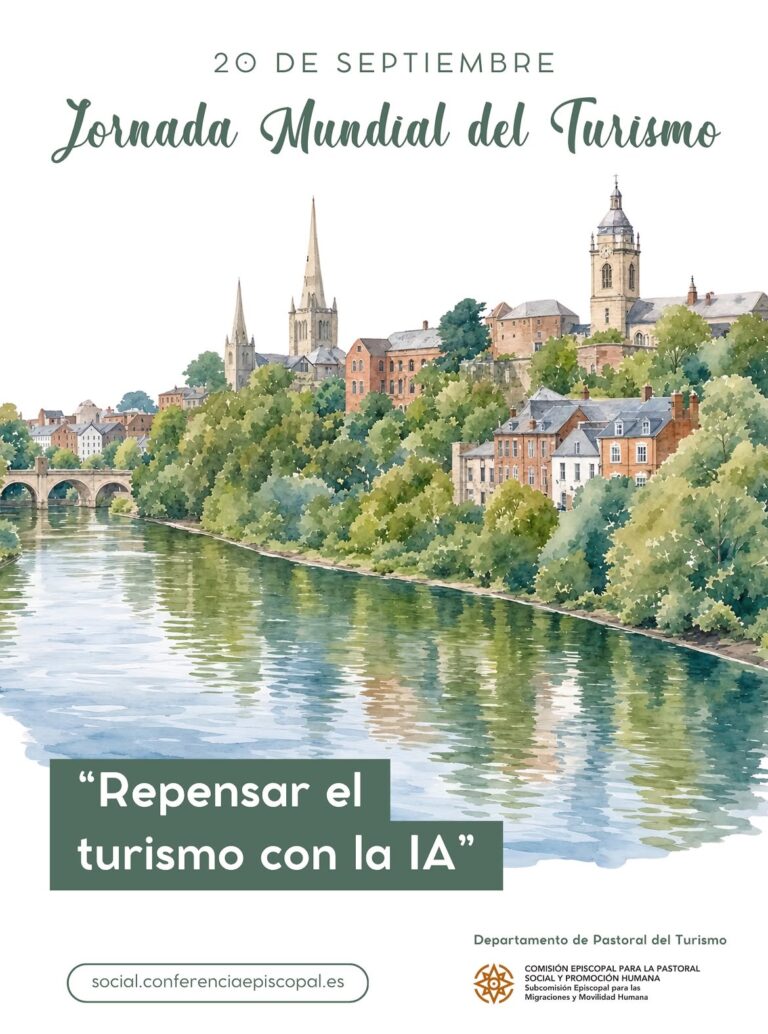
On September 20 we celebrate the World Tourism Day 2026, an opportunity to value tourism as a space for meeting, fraternity, knowledge and openness to others. This year the day invites “Rethinking tourism with AI” and he does so in light of the message of The Dicastery for Evangelization which we reproduce for you below.
The document invites us to reflect on the relationship between technological innovation, human dignity and the common good, recognizing the opportunities that artificial intelligence offers for more accessible, sustainable and inclusive tourism. It also draws attention to the risks of digital exclusion, the loss of authentic relationships and the unregulated use of data.An invitation to preserve the deepest meaning of the journey: encounter, human growth and discovery of others, remembering that no technology can replace the richness of the human experience.
MESSAGE
47TH WORLD TOURISM DAY
“Digital Agenda and Artificial Intelligence to redesign tourism”
September 27, 2026
World Tourism Day, which every year on September 27 invites the entire world community
to reflect on the meaning and value of this extraordinary form of meeting between peoples, proposes
this year a challenge of historic scope: understanding the role that artificial intelligence and transformation
digital can play in the tourism imagination of the future.
The Dicastery for Evangelization welcomes this topic with interest and pastoral responsibility. I don't know
This is a purely technical or economic issue: we are rather called to ask ourselves how we want
promote the human person through tourism, and how new technologies can really serve
the dignity of each person in view of the common good, as Pope Leo XIV affirms in the recent Letter
Encyclical Magnifica Humanitas: “Technology can heal, connect, educate, care for the common Home; but
It can also divide, discard, generate new injustices. In the abstract, this, in itself, is not a solution
to the problems of humanity, nor is it an evil in itself; but, specifically, it is not neutral, because
“it takes on the face of the one who conceives it, finances it, regulates it, uses it.” (Magnifica Humanitas, 9)
1. We live in a time of profound transformations. Artificial intelligence is not just a
tool; generates a new culture, with a new form of mediation between the person and the world. As
All mediation entails extraordinary possibilities, but also challenges that must be interpreted with caution.
wisdom and discernment. As Pope Leo XIV stated: “Artificial intelligence has undoubtedly opened
new horizons for creativity, but also raises disturbing questions about its possible
repercussions on humanity's openness to truth and beauty, and on our capacity for wonder
and contemplation. Recognize and respect what characterizes the human person and guarantees their growth
harmonious is essential to establish an adequate framework to manage the implications of intelligence
artificial” (Speech to the participants in the Conference “Artificial Intelligence and Care of Our Common
Home”, December 5, 2025). Therefore, the answer is not the rejection of technology, but its human use.
Artificial intelligence can become a valuable ally of sustainable and accessible tourism,
condition that it continues to be an instrument at the service of the person and does not become a system of
control, discrimination or exclusion.
2. Tourism is born from a desire as old as humanity: to know others, to discover new things.
horizons, let yourself be surprised by the beauty of creation and the richness of cultures. This wish is
deeply human and also carries a spiritual dimension. In him resonates that thirst for infinity that inhabits
in the heart of every person. Today, artificial intelligence can certainly make the journey easier: do more
accessible information, personalize experiences, optimize itineraries and reduce environmental impact. All
This is valuable. But no technology can ever replace the look that falls for the first time on a
never-before-seen landscape, the handshake between strangers, the emotion before a work of art or a place
sacred. The encounter with the other, with traditions different from one's own, can become an occasion for
growth. It is not about canceling differences or standardizing cultures, but rather about promoting an exchange
that enriches everyone. We therefore invite all actors in the tourism sector - institutions, operators
and travelers—to guard this irreducibly human dimension of tourism. The Pope reminds us that “The
new technologies open a horizon that extends in directions that, although intuitive, we cannot yet
foresee completely. This makes it more complex to evaluate its impact and long-term effects on the
dignity of people and the common good.” (Magnifica Humanitas, 4). Digital platforms and systems
of artificial intelligence must be designed and used in a way that favors the authentic encounter between
people and peoples, and do not reduce it to a mere virtual experience or a consumption of images. There is a
human and personal dimension that cannot be canceled without losing the deep meaning through which one travels.
This dimension must always be recognized, especially by those who work in the field of tourism, to
that a heritage passed from generation to generation is not lost.
3. There is, however, no shortage of reasons to look with healthy realism and positivity at the potential of
artificial intelligence applied to tourism. When guided by an ethical vision that places the
dignity of the person and respect for creation, technology can contribute significantly to
make tourism more equitable, accessible and sustainable. Think about people with disabilities, who through
of intelligent digital systems can today access places and experiences that were previously closed to them.
Local communities in developing countries can also find on digital platforms
new channels to promote their cultural and natural heritage. At the same time, it can be considered
possibility of monitoring and reducing the environmental impact of tourist flows, contributing to the care of
creation, as Saint John Paul II stated: “science and technology are a wonderful product of
human creativity gifted by God, they have provided us with wonderful possibilities and we have
gratefully benefited from them.” (Speech with scientists and representatives of the United Nations,
Hiroshima, February 25, 1981). In this sense, artificial intelligence can become a
instrument of fraternity and justice, not only of efficiency, provided that technological decisions
are guided by an authentic orientation towards the common good and not only by the logic of profit.
4. Pastoral lucidity also requires looking at the challenges that accompany this digital transformation. He
First is the loss of humanistic density when the tourist is considered a simple object, the trip a
product to optimize and the cultural encounter a spectacle to consume. In these cases, something essential is
lose. The tourist experience runs the risk of being reduced to what the algorithm foresees as desirable,
preventing us from discovering the amazement of the personal encounter, which is often the most valuable discovery. The amazement
beauty is, in fact, a form of knowledge that always goes further, that drives us to discover
personally new destinations that technology does not allow. Wonder is a true form of knowledge
that also opens to the spiritual dimension and introduces the path of contemplation of God, source of
beauty and Author of creation. There is also the challenge of digital exclusion. Those who do not have access to
technology, those who do not know how to use it or those who live in territories with low connectivity run the risk of
be even more marginalized in a sector—such as tourism—that for many communities represents a
essential source of sustenance. Unfair digitalization can deepen inequalities instead of
reduce them. Finally, the challenge of surveillance cannot be silenced. The massive collection of data on
traveler behaviors, if not adequately regulated, can become an instrument
of control incompatible with the freedom and dignity of the person. It is desirable, therefore, that the institutions
international organizations promote clear and binding regulatory frameworks that guarantee respect for human rights
fundamental in the era of artificial intelligence. In this context, the
words of Benedict XVI: “The key to development is an intelligence capable of understanding technique and
capture the fully human meaning of man's work, according to the person's horizon of meaning
considered in the globality of its being. Even when man operates through satellite or impulse
electronically at a distance, his actions always remain human, an expression of responsible freedom.” (Smileys
in Truth, 70).
5. We are called to rediscover the deep meaning of travel: not as an escape from reality, but as
as a path towards creation, towards the other and towards God. Tourism, when it is lived with authenticity and
responsibility, it can be a school of fraternity, an experience that broadens the heart and mind,
that educates in the richness of diversity and solidarity. Those who work in the tourism sector and those
They are engaged in the pastoral care of tourism and are therefore called to vigilance. The intelligence
artificial can redesign tourism and make it more attractive. To us, however, it is up to us
responsibility to pay attention to each person who undertakes a journey. It is necessary to preserve the vision of
the person as a relational, free being, capable of wonder and bearer of an inalienable dignity that no one
algorithm will never be able to fully capture.
January 26, 2022
✠ Rino Fisichella
Pro-Prefect
May 26, 2026
Memory of Saint Philip Neri